Overview of ADHD
ADHD (Attention-Deficit Hyperactivity Disorder) was traditionally seen as a condition largely affecting adolescents, that you ‘grew out of’. Now we know you don’t ‘grow out of ADHD’, you may develop skills to manage some of the internal (concentration) symptoms and the hyperactivity becomes less apparent as adults are more able to control their energy expenditure (doing exercise or taking jobs that are more physical).
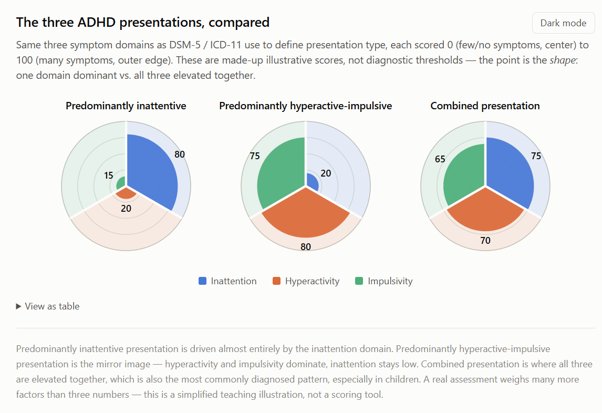
We also know that ADHD traits are not universal. As with all things in life, ADHD can present on a spectrum or continuum, this spectrum is best thought of as a circle, rather than a straight line. The main domains of the spectrum are concentration, restlessness and impulse control.
Generally, ADHD is subdivided into three categories for the purpose of diagnosis:
- Predominantly inattentive
- Predominantly hyperactive-impulsive
- Combined
There needs to be evidence of sufficient impact into your daily living in these domains for an ADHD diagnosis. Also your ADHD traits can change over time, thus the subtype becomes less informative.
At present we generally talk in a binary fashion of male and female presentations of ADHD; females tend to have less outward traits of ADHD (hyperactivity, jigging legs). We don’t know how many males have less outward symptoms, more of the inattentive/daydreamer symptoms.
One of the classic models to help explain ADHD is the ‘Brown model of Executive function’. As we’ve previously mentioned the prefrontal cortex could be viewed as being in charge of executive brain functions (the control centre). Brown suggested 6 areas of executive function that are often impaired in ADHD:
- Activation - Organising, prioritising and initiating work
- Focus - Sustaining and ability to shift attention
- Effort - Regulating alertness, sustaining effort
- Emotion - Managing frustrations, emotional control
- Memory - Working memory and memory recall
- Action - Self-regulation, monitoring context and speeding self up/down
The brain has several chemical signalling agents, dopamine and norepinephrine. These can be processed differently in people living with ADHD. Dopamine is commonly known as a reward hormone, it helps us become motivated to anticipate a reward. Norepinephrine helps us to stay focused on tasks. Most of the stimulant class of ADHD medication increases the levels of these signalling agents.
Physically, the brain region called the prefrontal cortex appears to be different when compared to someone without ADHD. The Prefrontal Cortex is like the management system of the brain, it helps to control and co-ordinate. If you have seen the film ‘Inside Out’ then the prefrontal cortex is the ‘headquarters’ where Joy, Sadness, Anger, Fear, and Disgust decide how to react to events.
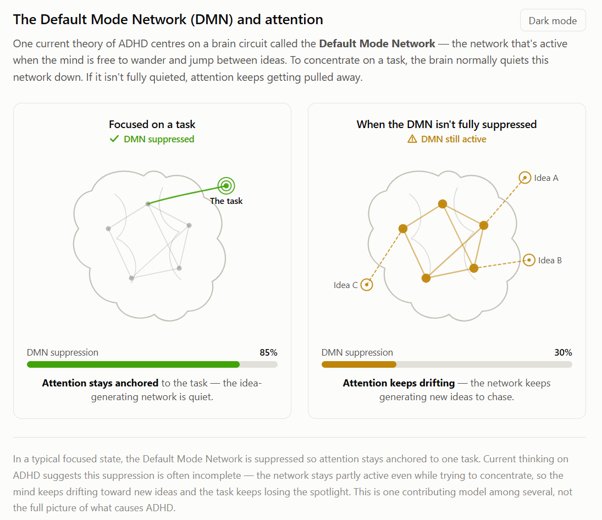
A more recent view on ADHD also suggests the brain has a default management system — called the ‘Default Mode Network’ (DMN). When the brain doesn’t have to focus on a certain task and it is free to create new ideas and leap from idea to idea this is the Default Mode Network. When we need to concentrate the Default Mode Network should be suppressed so you can focus on a task, if the DMN is not fully suppressed then the mind can wander and we become easily distracted.
There is a common view that certain people can’t have ADHD because they are able to concentrate on certain tasks (specific games/topics/activities). Hyperfocus is a trait of ADHD, an individual can become consumed by a task and is unable to take themselves away from the task. This seems paradoxical when talking about ADHD as a lack of focus; the theory is that hyperfocus is driven by an individual's interest and reward on a task. If a task stimulates, provides regular rewards and is of interest to the individual then someone with ADHD will be reluctant to stop.